SEARCH OUR WEBSITE
For Your Best Self Podcast | Episode 62 | Featuring Dr. Rebecca Novo, double board-certified plastic surgeon, in conversation with Kristen Roff, NP
Everyone seems to be talking about peptides right now, and if you’ve wondered what all the buzz is about, you’re in good company. On Episode 62 of the For Your Best Self podcast, Dr. Rebecca Novo sat down with Kristen Roff, NP, who brings more than 11 years of experience, to unpack what peptides actually are, who they may help, and how they fit into a thoughtful, personalized plan. Here’s a clear, practical guide based on their conversation.
Key takeaways
- Peptides are short chains of amino acids that act like signals. Kristen calls them “little text messages to your body.”
- The practice currently offers three most-requested formulas: GLOW (skin & recovery), NAD+ (focus & cellular support), and Tesamorelin (visceral fat).
- They’re designed to amplify a healthy lifestyle and pair well with skincare, surgery recovery, injectables, lasers, and GLP-1 programs.
- Every formula is prescribed after a medical evaluation and sourced from a licensed compounding pharmacy, not the black market.
What Are Peptides?
In the simplest terms, peptides are short chains of amino acids, the building blocks of proteins, that signal your cells to carry out specific tasks. Kristen describes them as “little text messages to your body,” nudging it toward things like healing, recovery, mental clarity, or weight-loss support. A few of the formulas below aren’t technically peptides, but they belong to the same family of treatment amplifiers designed to help your body work a little more efficiently.
The Three Most-Requested Formulas
GLOW: skin, tissue, and recovery
GLOW combines a copper peptide (GHK) with BPC-157 and TB-500. Together, these are aimed at skin and tissue repair, muscle recovery, and overall skin health, which is why Dr. Novo and Kristen often call GLOW the “gateway” formula. It tends to appeal to anyone focused on anti-aging and skin quality, as well as athletes and gym-goers looking to support recovery after training or an injury.
NAD+: focus and cellular support
NAD+ is the practice’s go-to cellular regenerator. It’s geared toward cognitive focus and mental sharpness and supports cell regeneration throughout the body. Kristen notes it’s especially popular with busy professionals who want steadier clarity and energy than their sleep schedule alone tends to allow.
Tesamorelin: targeting visceral fat
Tesamorelin targets visceral fat, the deeper, firmer fat that surrounds your organs, rather than the soft, pinchable subcutaneous fat most people associate with the belly or thighs. This distinction matters, because visceral fat carries higher health risks, including cardiac and metabolic concerns. As Dr. Novo explains, this often comes up in surgical consultations: procedures like liposuction or a tummy tuck address subcutaneous fat, while only weight loss and metabolic improvement can meaningfully change visceral fat.
How Peptide Therapy Works at Dermatology + Plastic Surgery
Your consultation
Everything starts with a conversation. During your consultation, Kristen reviews your health history and goals and screens for contraindications, the main ones being a history of cancer, pregnancy, and breastfeeding. From there, you might land on a single peptide or a personalized “stack” of several, depending on what you’re hoping to achieve.
Getting started and injections
All three formulas are given as small injections. Once your plan is set, your prescription can ship to the clinic or directly to your home, though Kristen prefers your first dose happen in the office, so she can show you how to draw it up and make sure you feel comfortable before you take it home. The needle is tiny, similar to an insulin needle, and most patients describe it as “less than a mosquito bite.” Injections go into subcutaneous areas you can pinch: the belly, the back of the arm, or the thigh, and how often you dose (often two to five times per week) is personalized to you and the peptide.
Cycling your peptides
The practice recommends cycling each peptide and staying on it no longer than three months consecutively. This keeps your body from getting too accustomed to the signal, so you continue to get a robust response. When it’s time to cycle off, Kristen often suggests trying a different peptide to target a new goal, or simply taking a break.
Follow-up and support
You’re not on your own once you start. Kristen and her team check in routinely, at least monthly, by phone or in person, and patients have direct phone access to Kristen for questions or any side effects along the way.
When Will You See Results?
Many patients begin noticing subtle changes within two to four weeks: easier workouts, faster recovery, more restful sleep, or less reliance on that mid-afternoon coffee. Kristen suggests giving therapy about six weeks for optimal results, and up to three months to experience its full potential. How long the benefits last depends largely on lifestyle: when the foundations are dialed in, the results tend to hold.
Peptides Work Best on a Healthy Foundation
Peptides are amplifiers, not magic. As Kristen emphasizes, they work best when the basics are in place: six to eight hours of quality sleep (four or five won’t cut it), good hydration, a balanced diet with enough protein, regular exercise to keep your metabolism active, and minimizing alcohol. Without that foundation, you simply won’t get the same response.
How Peptides Pair With Other Treatments
Synergy is a core part of the For Your Best Self philosophy, and peptides are a natural fit alongside the practice’s other offerings.
Peptides + skincare
Acting as messengers, peptides signal the skin to produce more collagen, elastin, and keratin, supporting firmness, elasticity, and a stronger skin barrier. They complement skincare ingredients like hyaluronic acid, antioxidants such as vitamin C, and anti-aging agents like retinol.
Peptides + surgical recovery
This is one of Dr. Novo’s favorite pairings. Peptides may help accelerate healing, reduce inflammation, and support tissue repair by encouraging the body’s natural cellular regeneration. BPC-157 (its name stands for “body protecting compound”) and TB-500 target muscle, tendon, and skin recovery, so running GLOW through the healing window after a procedure may be a meaningful accelerator.
Peptides + injectables and laser
Peptides are often combined with injectables such as Botox, fillers, and biostimulators, as well as laser treatments, to help enhance and extend results. Because lasers and some injectables temporarily disrupt the skin barrier, the copper peptide in particular may help calm inflammation, soothe irritation, and speed healing afterward.
Peptides + GLP-1 weight-loss programs
Peptides also pair well with a GLP-1 weight-loss program. GLOW can support hair and nails, helpful when weight loss brings some hair thinning, and Tesamorelin can address visceral fat as an add-on, whether you’re microdosing, maintenance dosing, or actively losing weight.
Safety and Sourcing: Why It Matters
Safety and transparency are central to how the practice operates, and peptides are an area where that matters enormously. Kristen is candid about the risks of black-market or unlabeled peptides: if it sounds too good to be true, it usually is. Every formula offered through the practice is prepared by Greenwich RX, a 503A compounding pharmacy that makes each prescription to order, no mass production, following FDA and United States Pharmacopeia (USP) guidelines and using premium-grade ingredients through the Professional Compounding Centers of America. Each vial arrives with the patient’s name on it, clearly labeled in English with an expiration date.
Just as important: don’t order peptides on your own. These amino acids signal hundreds of processes in the body, so they need to be guided and monitored by an experienced medical professional. The most common side effect Kristen sees with these particular peptides is a mild injection-site reaction, something she has simple strategies to minimize.
What Does Peptide Therapy Cost?
As shared in the episode, monthly pricing starts around $320 for GLOW, $240 for NAD+, and $180 for Tesamorelin. Because every plan is personalized, and many patients combine peptides into a stack, your actual investment is determined at your consultation.
An important note. This article is for educational purposes and reflects a conversation from the For Your Best Self podcast. The compounded peptide therapies discussed (GLOW, NAD+, and Tesamorelin) are not FDA-approved for the uses described and are prepared by a licensed 503A compounding pharmacy. Peptides are not a substitute for a healthy lifestyle or medical care, individual results vary, and no outcome is guaranteed. Before beginning any peptide therapy, please schedule a medical evaluation to discuss the potential benefits, risks, side effects, alternatives, and uncertainties with Kristen Roff, NP or your own healthcare provider.
Frequently Asked Questions
What are peptides?
Peptides are short chains of amino acids, the building blocks of proteins, that signal your cells to perform specific tasks. They’re used to help support healing, recovery, focus, and weight-loss goals.
Are peptides FDA-approved?
The compounded peptides discussed here are not FDA-approved for these uses. They’re prepared by a licensed 503A compounding pharmacy and require a medical evaluation before you begin. Regulatory status continues to evolve, so your provider is the best source for the current picture.
What’s the difference between GLOW, NAD+, and Tesamorelin?
GLOW supports skin, tissue, and muscle recovery; NAD+ supports cognitive focus and cellular regeneration; and Tesamorelin targets visceral fat around the organs.
How are peptides taken, and do they hurt?
They’re given as small subcutaneous injections using a tiny insulin-style needle, into areas like the belly, the back of the arm, or the thigh. Most patients describe it as less than a mosquito bite. Dosing frequency is personalized.
How long until I see results?
Many patients notice changes within two to four weeks. About six weeks is suggested for optimal results, and up to three months to reach full potential. How long benefits last depends on your lifestyle.
Who is not a candidate?
The main contraindications are a history of cancer, pregnancy, and breastfeeding. A consultation screens for these and other considerations.
Are these peptides safe?
When prescribed and monitored by an experienced provider and sourced from a licensed compounding pharmacy, peptides can be used thoughtfully. Avoid black-market or self-ordered peptides. The most common side effect with these formulas is a mild injection-site reaction.
How much do peptides cost?
Monthly pricing starts around $320 for GLOW, $240 for NAD+, and $180 for Tesamorelin, and is personalized at your consultation.
Curious Whether Peptides Fit Your Goals?
The only way to know is a personalized consultation. Sit down with Kristen Roff, NP at Dermatology + Plastic Surgery to review your health history, talk through your goals, and explore whether GLOW, NAD+, Tesamorelin, or a custom stack is right for you.
CONTACT US / REQUEST APPOINTMENT
Fill out the form below or call us at (321) 395-3298 to schedule your appointment or consultation.
REVEAL YOUR MOST Radiant Skin
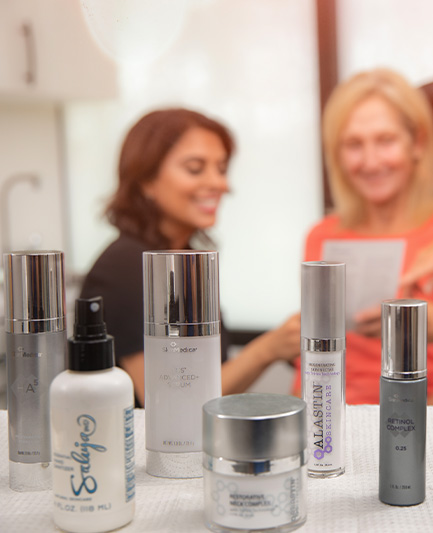
Dermatologist Dr. Anita Saluja and plastic surgeon Dr. Rebecca Novo have created an online shop for your convenience. They have curated scientific skin care products that they believe will deliver results: For Your Best Self. And you can always contact our office with any questions.
SHOP OUR SKIN STORE